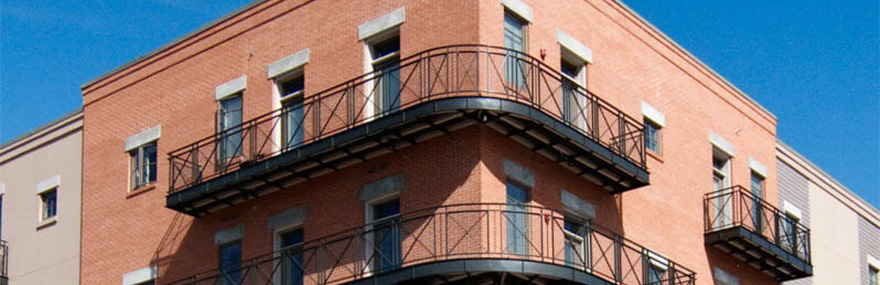
The final stage of the $32 million project is scheduled to begin next month at the historic Touro-Shakspeare Home in Algiers, which is being converted to 52 apartments for low-income seniors.
With the help of a $6 million loan from the city of New Orleans, HRI Communities this fall completed 10 months of structural stabilization work to stave off further decay. In December, the developer secured the $26 million in financing to complete the renovation phase.
“Nothing was easy or obvious,” said Chris Clement, HRI’s senior vice president for development.
Built in 1933, the Touro-Shakspeare Home operated as a city-owned nursing home prior to Katrina but has been vacant and decaying ever since.

“The fact that this building was still standing, given the condition that it was in, is really a testament to the nature of this construction,” Clement said on a recent visit.
Public housing pioneer
Touro-Shakspeare’s origin traces back to before the Louisiana Purchase. Judah Touro, a Rhode Island businessman, moved to New Orleans in 1801 after his uncle rejected his request to marry his cousin.
Touro went on to become one of the nation’s most prominent Jewish philanthropists in the first half of the 19th century. When he died without an heir in 1854, he included in his will an $80,000 gift to build an “Alms House” in New Orleans for the “prevention of mendicity” — free housing for the elderly and others in need. His will called for the almshouse to be operated “conjointly” with the mayor, once operational.

Its first iteration was a Gothic castle-style structure on the site of what is now the “Rusty Rainbow” bridge to Crescent Park in Bywater. Near the end of the Civil War, it burned to the ground, after a fire broke out in a makeshift kitchen.
After the war, the almshouse’s remaining assets were transferred to the city with a provision restricting their use for any purpose other than Touro intended. With the help of revenue from reformist Mayor Joseph Shakspeare’s gambling tax and federal compensation for its pre-fire occupation, it reopened at the corner of Daneel Street and Nashville Avenue Uptown, operating there from 1883 until 1927.
Algiers years
The current version, a three-story, 72,000-square-foot structure, was designed by architect William Burk in the Jacobean Revival style with neoclassical elements. It sits on more than 7.5 acres set back from General Meyer Avenue and is surrounded by oak trees and open green space.
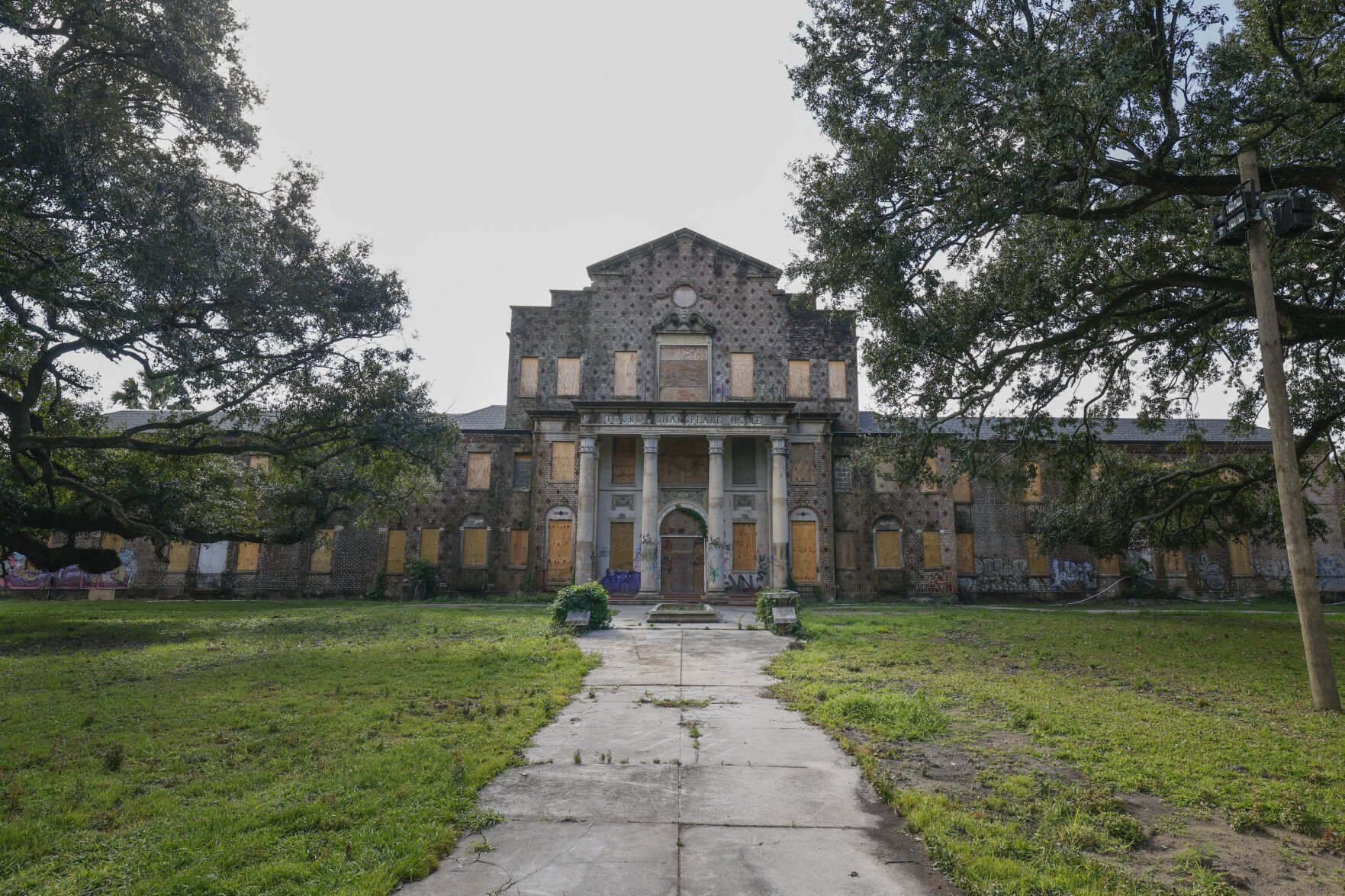
For decades, it functioned as senior housing. Ahead of Hurricane Katrina, its 175 or so residents were evacuated. It has been vacant ever since.
In the years that followed, the building became one of many public eyesores in the city. A Nagin administration effort to restore it went nowhere. In 2015, the Louisiana Landmarks Society listed it among the most endangered historic sites in the state, threatened by “demolition by neglect.”
“That’s when I started getting online and I’m coming across all these videos that people were breaking in there and exploring and stuff, and it just kept me going,” said Arthur Ruiz Jr., who grew up in the area and has advocated for the building’s preservation over the past decade. “It was like it was contagious.”
Ruiz, who contributed to efforts to secure landmark designation for the building, blamed city officials for allowing the building to fall into such disrepair. He recalled a conversation with a FEMA official who said city officials weren’t interested in restoring the building and preferred it torn down.
“As every year went by, my God, it was worse and worse,” Ruiz said. “Because of the city not securing the roof and not securing exterior windows.”
Almshouse to affordable housing
Under growing pressure from preservationists and Algiers homeowners weary of a rotting building beside a public park and residential neighborhood, the Cantrell administration issued an invitation to bid on its restoration in 2021. HRI was one of two developers to submit bids. The other one pulled out, and HRI wound up with the 99-year ground lease.
The project has been financed through a combination of low-income housing tax credits, tax-exempt bond debt and a disaster recovery loan from the Louisiana Housing Corporation. The funding stack also includes a property tax abatement deal, federal and state historic tax credits and private financing.
When HRI first took responsibility for the property — at the time overgrown by nature and overrun by vagrants — the condition of the property was so bad, the firm couldn’t even find an insurance company willing to quote liability coverage.
“We have seen a lot of unstable properties, unsavory properties,” Clement said. “We’ve never had an insurance company come out here and say, ‘Not even for all the money in the world, we can’t write you a policy.’”

During the past two decades, the structure suffered pervasive water intrusion that rotted away any remaining wood elements, collapsed the roof and rusted out a majority of the steel trusses supporting its concrete floor. So much of the building had collapsed that workers could not separate the rubble from the asbestos.
“So we had to dispose of all of the debris as asbestos, just to be safe,” Clement said.
Despite the extensive damage from years of neglect, decorative details and key elements of the building’s original design remain, now set to take on new uses when HRI’s renovation is complete.
Originally divided for different genders, it features a pair of symmetrical enclosed courtyards featuring ornamental fountains and stone grotesques along its balconies.

Its centerpiece is a nondenominational chapel — whose stained glass windows were mysteriously removed but whose plaster roof has been partially restored — set to take on a new life as a community room.
Once completed, its one-bedroom apartments will be reserved for residents aged 62 and older who earn no more than 50% of the area median income, or about $36,000 for a two-person household.
Though Touro-Shakspeare was built as a municipal building for the indigent and infirm, experts say its designer always intended for it to be as aesthetically pleasing as a private home — an architectural legacy that continues into its next incarnation.
“When you walk around, you can see where actual artisans touched every piece of this building,” Clement said. “It was by no means an afterthought; it was there to provide a good place where people would be proud to live.”